Knowledge · Stress and Body
When chronic stress becomes physical symptoms
What research shows about the stress axis, cortisol, and the body's recovery. And where the limits of these findings lie.
Chronic stress does not stay in the head. When activation never fully settles, sleep, digestion, hormonal rhythm and immune balance shift for good. That produces physical complaints without one clear single finding. Relief does not start with more discipline, it starts with the system learning to switch down reliably again.
- Chronic stress does not stay in the head. Through the stress axis and the hormone cortisol it leaves measurable traces in the immune system, cardiovascular system, and metabolism.
- Acute stress mobilizes. Chronic stress dysregulates and promotes silent, low grade inflammation.
- Many seemingly separate symptoms such as poor sleep, a sensitive stomach, or inner restlessness can share a common origin in a persistently activated stress system.
- Regulation, meaning the return to recovery mode, is a real and well documented lever. It does not replace medical assessment but complements it.
Reading time about 6 minutes. All claims are backed by sources.
The starting point
The tests are unremarkable, the body is not
Many people know this situation. Blood work is fine, the ECG shows nothing, and yet exhaustion, poor sleep, a sensitive stomach, or an inner restlessness that will not subside remain. Some of these complaints cannot be explained by looking at a single organ, because their origin does not lie in one organ but in a system that is under sustained load.
Stress research over recent years has described in detail how prolonged strain becomes measurable physical change. This article summarizes the well supported state of the evidence and marks where the data are clear and where they are not.
The stress axis
What runs in the body under load
At the center of the physical stress response is the HPA axis, the chain of hypothalamus, pituitary, and adrenal cortex. Under load the body releases the hormone cortisol through this chain. Short term this is useful. Cortisol provides energy, sharpens attention, and dampens inflammation. After the load a feedback loop brings the cortisol level back down and the system settles (review: Chronic Stress Pathways, Int. J. Environ. Res. Public Health, 2024).
The HPA axis with feedback. After the load, a negative feedback loop lowers the cortisol level again.
The tipping point
From acute to chronic
It becomes problematic when the load does not end. If the HPA axis stays chronically active, feedback loses its effect, and the natural daily rhythm of cortisol falls out of step (Chronic Stress and Autoimmunity, Int. J. Mol. Sci., 2025). The sum of this wear is described technically as allostatic load, the price the body pays for staying too long in adaptation mode.
The difference between acute and chronic stress is not gradual but fundamental. Acute stress activates, mobilizes, and even strengthens defense short term. Chronic stress does the opposite. It depletes and pulls regulation out of balance (HPA axis and neuroinflammation, mini review, 2025).
After acute stress the cortisol level returns to baseline. Under chronic load it stays dysregulated.
What is measurable
Silent inflammation
Under chronic stress, the immune system shifts toward sustained, low grade inflammation. Studies show elevated inflammation markers such as IL-6, TNF-alpha, and CRP, along with altered immune responses (HPA function and immune markers, 2025). This silent inflammation is now seen as a link between chronic psychological strain and higher risk for cardiovascular disease, metabolic disorders such as insulin resistance, and other inflammatory processes (Chronic Stress Pathways, 2024).
Chronic strain does not stay in the head. It leaves traces in several body systems at once.
| System | What happens under chronic stress |
|---|---|
| Immune system | Shift to low grade chronic inflammation, elevated markers such as IL-6, TNF-alpha, CRP |
| Heart and circulation | Higher cardiovascular risk. In acute form up to Takotsubo syndrome |
| Metabolism | Altered blood sugar, facilitated insulin resistance |
| Digestion | Disturbed regulation in the gastrointestinal tract |
| Sleep and nervous system | Disturbed cortisol rhythm, difficulty winding down, restless sleep |
A documented example
The broken heart is not a metaphor
That psychological strain can hit an organ directly is shown by a well documented condition, Takotsubo cardiomyopathy, colloquially known as broken heart syndrome. After a strong emotional or physical shock the left ventricle's pumping function can temporarily fail, triggered by a flood of stress hormones, and without any blocked coronary arteries (Takotsubo syndrome, case report and review, 2023). The condition is usually reversible and predominantly affects postmenopausal women.
It is one of the clearest examples that the split between psychological and physical is biologically not clean. A feeling can change measurable heart function.
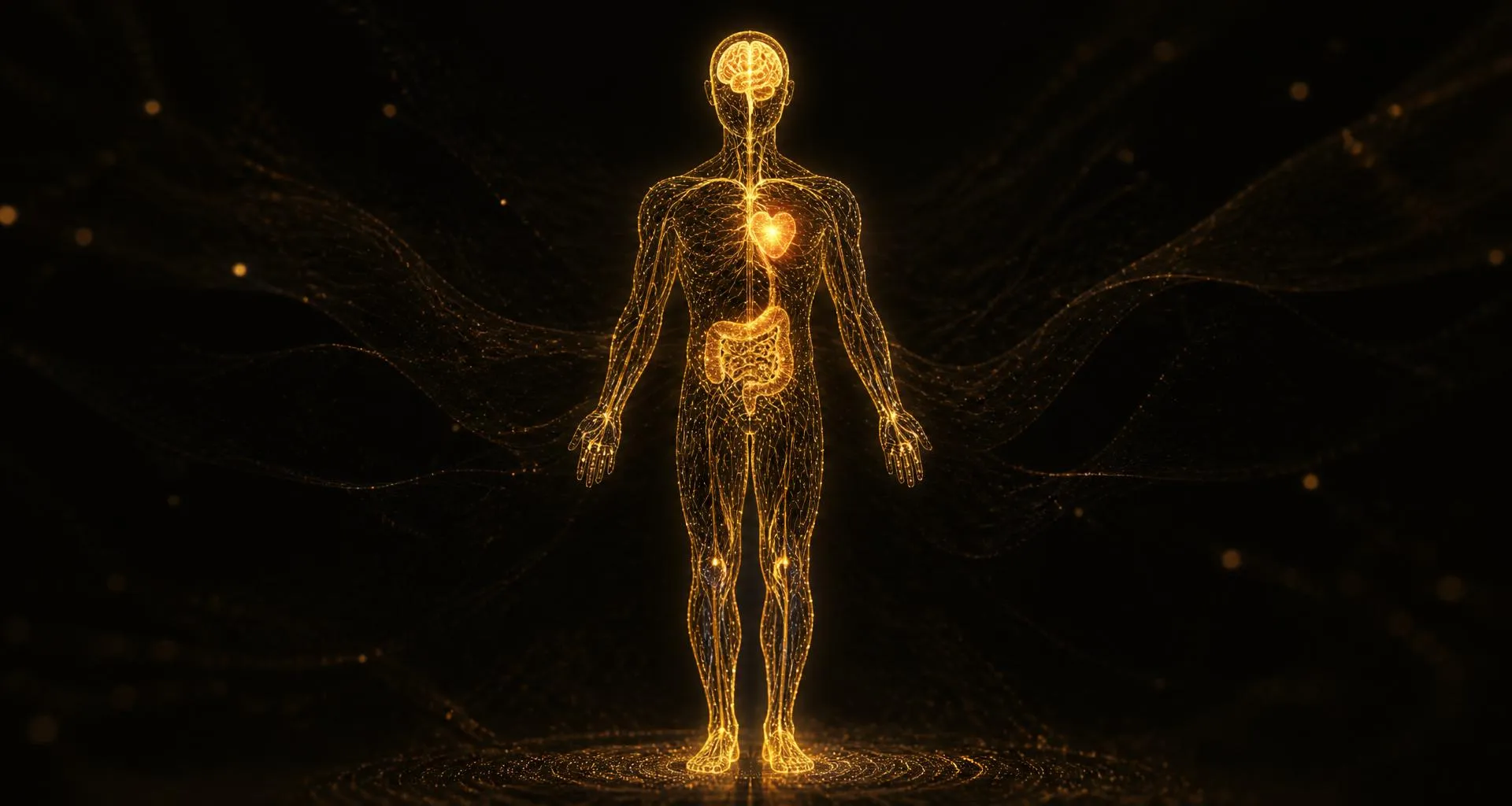
Artistic depiction. Not a medical illustration.
Origin instead of symptom
Why the loudest symptom is rarely the origin
From this perspective, a common pattern appears in a different light. When only the loudest symptom at any given time is treated, the shared origin of several symptoms often remains untouched. Something for sleep, something for the stomach, something for tension, while the persistent activation of the stress axis underneath goes unaddressed.
Research suggests looking beyond the single organ to the regulating system. This does not replace medical assessment. It adds a layer that rarely fits into a short consultation.
Regulation
What recovery means physiologically
Adaptation mode has a counterpart in the nervous system, the parasympathetic branch, responsible for recovery, digestion, and regeneration. Physiologically, regulation means reliably reaching this counterpart again instead of staying in alarm mode.
Behavior based stress reduction programs that target exactly this are linked in reviews to measurable effects on stress markers (Behavioral Stress Reduction Programs, 2024). One simple, widely used element is slowed breathing with a pronounced long exhale, which short term strengthens the parasympathetic side. These approaches are tools, not a replacement for treating serious or persistent complaints.
Regulation does not mean abolishing load, but restoring the balance between activation and recovery.
An image from materials research
Systems that can close themselves
A mental model for the idea that systems, under the right conditions, do not just wear out but can also close again comes from materials research. In 2023, a team at MIT showed why Roman concrete has lasted two millennia. Small lime inclusions, long considered a defect, act as built in repair. When a crack forms and water enters, these inclusions dissolve and refill the crack with newly formed lime (MIT News, 2023, original study in Science Advances).
This is not from medicine and proves nothing about the body. But it illustrates a principle that physiological systems also know. Under the right conditions, self repair is not a miracle but a property of the system.
Roman concrete whose lime inclusions reseal fine cracks with new lime.
Placing and limits
What these findings say, and what they do not
For all the evidence, caution is warranted. A statistical association is not a single cause. Chronic stress raises risks and shifts physiological balances, but it is rarely the sole cause of a disease.
Popular sharpenings, for example that suppressed feelings directly cause specific severe diseases, go beyond the evidence and are not supported in that unequivocal form. And no stress or regulation model replaces medical assessment of persistent or serious symptoms.
The robust statement is both more cautious and more practically meaningful. Sustained strain leaves measurable traces, and its regulation is a real lever for health.
| Claim | Status |
|---|---|
| Chronic stress promotes low grade inflammation and raises cardiovascular and metabolic risks | well supported |
| Acute emotional shock can temporarily impair heart function (Takotsubo) | well supported |
| Stress reduction has measurable effects on stress and inflammation markers | well supported |
| Suppressed feelings are the direct single cause of severe diseases such as cancer | disputed, not supported |
| Chronic stress is the sole cause of a specific disease | disputed, not supported |
Sources
Sources
- Chronic Stress Pathways and Behavioral Stress Reduction Programs, Int. J. Environ. Res. Public Health, 2024. https://www.mdpi.com/1660-4601/21/8/1077
- Chronic Stress and Autoimmunity, HPA Axis and Cortisol Dysregulation, Int. J. Mol. Sci., 2025. https://www.mdpi.com/1422-0067/26/20/9994
- HPA function, cortisol rhythm and immune markers, 2025. https://www.ncbi.nlm.nih.gov/pmc/articles/PMC12563903/
- HPA axis, neuroinflammation, mini review, 2025. https://www.ncbi.nlm.nih.gov/pmc/articles/PMC11988747/
- Takotsubo cardiomyopathy, case report and review, 2023. https://www.ncbi.nlm.nih.gov/pmc/articles/PMC10715676/
- Roman concrete, self healing through lime inclusions, MIT News, 2023. https://news.mit.edu/2023/roman-concrete-durability-lime-casts-0106
- Masic et al., hot mixing, Science Advances, 2023. https://www.science.org/doi/10.1126/sciadv.add1602
This article is for information and is not medical advice. Persistent or serious symptoms warrant medical assessment.