Gut Health Coaching
A gut health coach for the digestive system research keeps pointing to.
Stanford ran the study. The result was so clear it changed how scientists think about the gut. As a gut health coach, I use that evidence to help you rebuild yours from the root. Let's get into it.
Here is the part that matters. The people who just ate more fiber? Barely changed. It was not about eating more. It was about what was alive in their gut.
The one thing to understand
Your gut is not a tube. It is a garden.
Most people picture digestion like a pipe. Food goes in, waste comes out. That is not it.
Your gut is more like a patch of soil. Living soil, packed with trillions of tiny bacteria. The more kinds you have living in there, the better you feel. Good digestion. Steady energy. Even a steadier mood.
Scientists have a boring word for this. Diversity. A diverse garden is a healthy garden.
Here is the problem. Most people's inner garden has been sprayed, starved, and left for dead. Antibiotics wiped it. Processed food starved it. Stress trampled it.
Nothing grows in dead dirt. That is why you feel like this.
Almost everything that follows, the bloating, the weird food reactions, the low mood, comes back to this one idea. So keep the garden in your head as you read.
A wiped-out gut
low diversity, few kinds of bacteria
A thriving gut
high diversity, many kinds of bacteria
Same person, two different inner gardens. Diversity is the whole game.
Sound familiar?
Which of these is your gut doing?
Tap the ones you recognize. No judgment. This is just to see the pattern.
You tapped 0 of these.
Whatever you tapped, the thread connecting them is usually the same. A garden that lost its diversity. Let's walk through the big ones.
The part everyone gets wrong
Gluten probably isn't your villain.
Walk into any health store and someone will tell you to cut gluten. So people do. Sometimes they feel better, mostly they don't, and they end up scared of bread for no reason.
Here is the honest truth. There is a real difference between a food allergy and a food intolerance, and almost nobody explains it.
An allergy is your immune system firing an alarm. It treats a food like a threat and attacks. This can be serious, even dangerous. True celiac disease is in this family, a real immune condition, and for those people gluten genuinely is the enemy. But that is a smaller group than the internet makes it sound.
An intolerance is different. It is not your immune system. It is a digestion problem. Your gut just cannot break the food down well, often because the bacteria that used to do that job are missing. So you get bloating, gas, and discomfort, but it is not an attack, it is a struggling garden.
So when someone says "I'm gluten intolerant," very often the real story is a depleted gut that cannot handle much of anything well right now. Gluten gets the blame. The empty garden was the real issue.
Cutting one food after another rarely fixes that. Rebuilding what is living in there does.
Two different things people keep mixing up.
Food allergy
Food intolerance
Most people who think they are intolerant have a depleted gut, not an allergy.
How the garden gets wiped
The most common way people wreck their gut without knowing.
Antibiotics save lives. Sometimes you need them, full stop. But here is what no one tells you when you take them.
Antibiotics do not aim. They carpet bomb. They kill the bad bacteria making you sick, and they kill huge amounts of the good ones too. One round can slash the diversity of your inner garden. And the research is clear that for some people, it does not bounce back for months, sometimes longer.
I know this one personally. After an accident, I was on antibiotics for weeks. My arm healed. But my gut got wiped. I became sensitive to foods I had eaten my whole life, and my digestion was a mess for a long time. Nobody warned me that was even possible.
Here is the part that surprises people most. A wiped-out gut does not just affect your stomach. It can affect your mood. Most of your feel-good chemicals are made with help from your gut bacteria. Strip the garden bare, and you can feel flat, foggy, or down, and never connect it to your digestion.
The science backs this up carefully. Large reviews have found that antibiotic use is associated with a higher risk of depression later, and the leading explanation is exactly this, antibiotics reduce gut diversity. It is an association, not a guarantee. But the link is real, and it lines up with what so many people quietly experience.
What one round of antibiotics can do to your inner garden.
Before
diverse, healthy
Antibiotics
diversity wiped
Months after
slow, uneven regrowth
With the right food
replanted
For some people the garden regrows on its own. For many, it needs replanting on purpose.
How you rebuild it
You don't starve a garden back to life. You replant it.
This is where most advice gets it backwards. People try to fix a gut problem by removing more and more foods. But you cannot shrink your way to a thriving garden. You have to feed it and replant it.
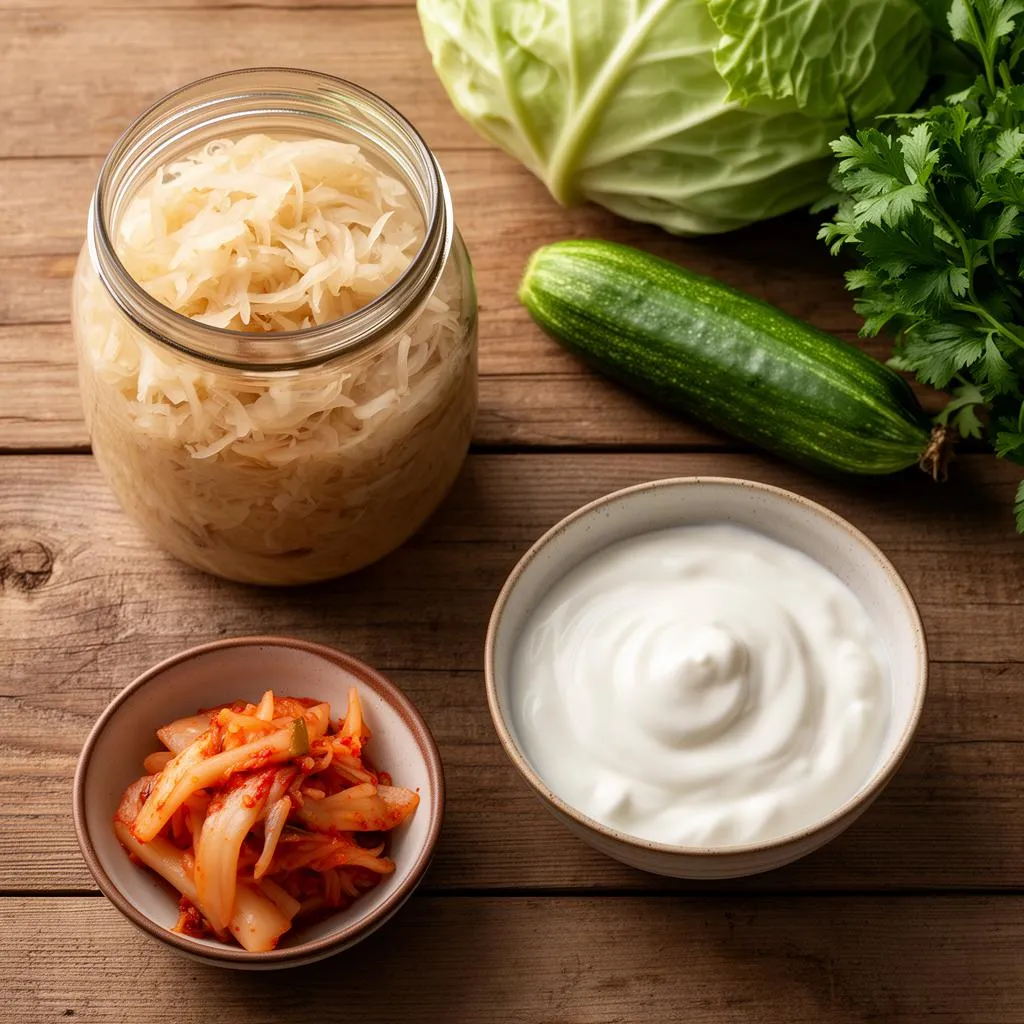
Remember that Stanford study from the top? Here is why it matters so much. They put one group on lots of fiber, and another group on fermented foods, things like sauerkraut, kimchi, yogurt, kefir. Ten weeks later, the fermented food group had a more diverse gut and lower inflammation across the board. The high-fiber group, surprisingly, barely moved on diversity.
The lesson is simple enough for a kid. Fermented foods bring living bacteria into the garden. Fiber only helps once there is something alive in there to feed.
This is exactly what pulled me out of my own mess. Not a magic pill. I cut the processed food, I cooked my own meals, I ate a lot of fermented food like homemade sauerkraut, more real protein, fewer empty carbs. Slowly, the garden came back. So did my energy.
None of this is about being perfect. It is about stopping the spraying and starving, and starting the replanting.
The simplest version of the fix, before any fancy plan:
Stanford, 10 weeks, 36 people.
More fiber only
Gut diversity
Inflammation
Fermented foods
Gut diversity
Inflammation
Fermented foods raised diversity and lowered inflammation. Fiber alone mostly did not. Replanting beats restricting.
Start here
Add fermented foods
A little sauerkraut, kimchi, kefir, or plain yogurt most days. Living food for a living garden.
Cut the processed stuff
The packaged, ultra-processed food starves the good bacteria. Less of it changes a lot.
Cook real meals
Simple, real ingredients you cooked yourself beat anything from a box.
Eat calm, not rushed
Your gut digests best when you are not in a rush. Slow down before you eat.
The honest part
When the simple stuff isn't enough.
For a lot of people, the basics above are genuinely most of the battle. Start there.
But if you have been at this a while, cutting foods, trying probiotics, and your gut still runs your life, that is a signal. It usually means the garden needs a real, guided rebuild, not another food removed from the list.
That is the part I help with as a gut health coach. Figuring out what actually wiped your garden, and replanting it in the right order for your body and your life. Not a generic plan off the internet. Yours.

Why I get this
I rebuilt my own gut from zero.
I did not learn this from a textbook. I learned it lying awake with a wrecked gut after weeks of antibiotics, sensitive to food, drained, and getting no real answers.
I had to treat my own body like a problem to solve. What I figured out, the replanting, the real food, the patience, is exactly what I now help other people do as a gut health coach, without the year of guessing it took me.
Let's rebuild your garden.
A free Initial Consultation to look at what is actually going on in your gut and whether working together is a fit. No pressure, no number to react to before we know we can help each other.
Sources
- Fermented-food diet increases microbiome diversity, decreases inflammatory proteins. Stanford Medicine, 2021 (published in Cell). https://med.stanford.edu/news/all-news/2021/07/fermented-food-diet-increases-microbiome-diversity-lowers-inflammation.html
- Food Intolerance: allergy vs intolerance explained. Cleveland Clinic. https://my.clevelandclinic.org/health/diseases/21688-food-intolerance
- Gut microbiota and its metabolites in depression, including antibiotic association. eBioMedicine (The Lancet), 2023. https://www.thelancet.com/journals/ebiom/article/PIIS2352-3964(23)00092-0/fulltext
- Restoring microbial diversity after antibiotic disturbance. PMC (peer-reviewed). https://www.ncbi.nlm.nih.gov/pmc/articles/PMC10536327/
Educational content only, not medical advice. Patrick Labella is an integrative health coach, not a physician. Consult a qualified healthcare provider for diagnosis or treatment.