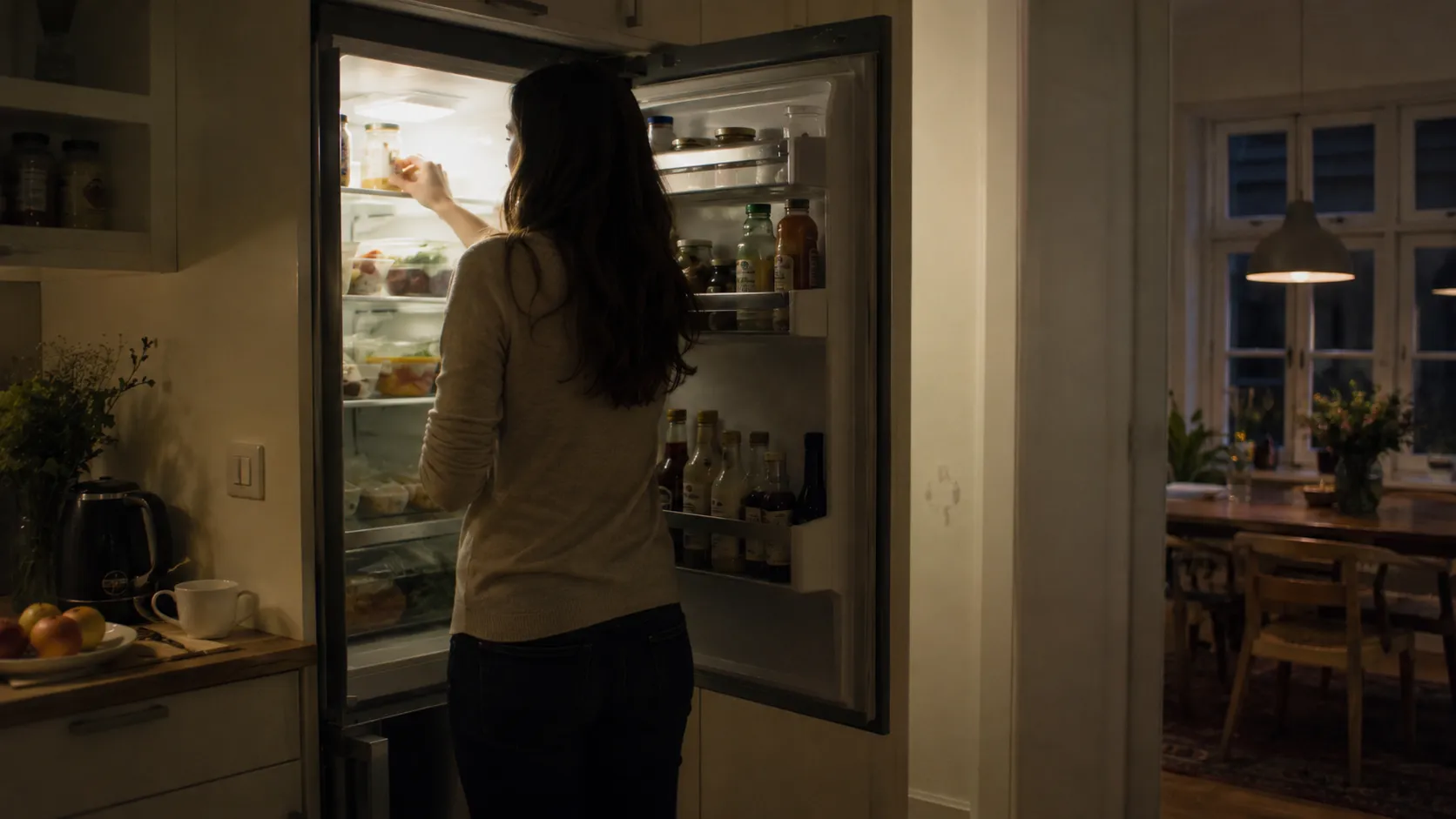
It's 9pm. You're at the fridge again. You're not even hungry.
You ate dinner two hours ago. You promised yourself today would be different. And here you are. There is a reason this keeps happening, and it has almost nothing to do with willpower.
The ice cream after the fight.
Picture this. You just had a hard conversation. Maybe a fight with your partner. Maybe a brutal day at work. It is 9pm, you walk past the kitchen, and you find yourself in front of the fridge with the ice cream in your hand. You eat half the tub.
Quick question. Were you hungry? Probably not. You ate dinner.
So what did you actually eat? You wanted to feel better. You did not want to feel full.
And here is the part nobody tells you. Your brain is not doing this because you are weak. It is doing this because it learned this exact move a long, long time ago, when you were small. Something hurt. Someone gave you something sweet. The hurt got smaller. Your brain wrote that down: sugar makes pain smaller.
That note has never been thrown out. Today, 30 years later, you have a hard evening and your brain reaches for the same move. The ice cream at 9pm is not greed. It is a 30 year old prescription.
And almost every fight you have with food, every "why can't I just stop", every late-night fridge run, sits on top of this one fact. That is what the rest of this page is about.
Tap the moments you eat when you're not hungry.
Just notice. No judgment. This is the pattern.
Whatever you tapped, you are reading something the food cannot give you back. Let's look at what is actually happening in your body when this hits.
Your body has chemicals running this. Knowing them changes the game.
This is the part that always blows people's minds. The pull to eat when you are not hungry is not in your head. It is in actual chemicals that move through your body every day. There is solid science here, including a 2025 review in Nutrients on stress, eating, and mental health, and a 2025 paper in the Journal of Neurochemistry on stress and appetite that pulls a lot of it together.
Basically here is what they found. Four chemicals are doing most of the work, and they are working on you, not against you. They are just running ancient programs in a modern world that does not fit them.
Let's meet them, one by one. After each one, you will probably nod, because they explain something specific you have lived for years.
Here is the move that changes things. The next time you feel that pull to the fridge, do not start with "stop yourself." Start with "which chemical is this?" Is this dopamine pulling me before I even know why? Is this cortisol after a stressful afternoon? Is this serotonin wanting carbs after a brutal day?
You cannot fight chemistry with willpower. But you can stop pretending it is a moral failing. That alone is huge.
Even Oprah figured this out on live TV.
Oprah Winfrey has talked about her relationship with food more openly than almost anyone in public life. On her own show many years ago, she had a moment that has stuck with people who care about this topic.
She had just told someone no on the phone, something she had a hard time doing. She hung up. Then she ate. And she said out loud, on camera, "what I am really feeling is every time I have been hit as a child... what I recognize as I am stuffing myself is that I still feel like if I don't do what pleases the other person, that person has the power to destroy me." There is a write-up of this here.
Basically, here is what she found out about herself in that one moment. The food was not about hunger. The food was a place to put a feeling that had been with her since she was a little girl. A feeling that saying no to someone might make her unsafe.
She has talked about this many times since. In her recent interview with the Today Show about her book "Enough", she said the years of weight struggle were never really about food. They were about using food to deal with feelings that started in childhood. Read that again. That is one of the most powerful and most successful people on Earth, saying out loud the same thing that is true for most of us.
If this can be true for Oprah, it can be true for you too. And that is good news. Because if it is feelings, not food, then you have something real you can actually work on.
Stop looking for the one diet that works.
Quick honest word on diets. You have heard them all. Keto. Vegan. Carnivore. Intermittent fasting. Mediterranean. Low carb. High carb. Each one has people who swear it changed their life. Each one has people who swear it ruined their health.
They are both right. Because no two bodies are the same. Your genes are different. Your gut bacteria are different. Your stress is different. Your sleep is different. Your relationship with food is different. So the diet that worked for your friend may genuinely not work for you, and that is not a personal failure, that is biology.
This is called bio-individuality. It is not a wellness slogan. It is the reason that one-size-fits-all plans almost always fail in the long run.
The honest answer is not to find the perfect plan online. It is to figure out what your body actually responds to, by paying attention and adjusting. Your body is the only authority that matters here. Coaching helps you learn to listen to it.
But there's one rule almost no one escapes.
Even with all that individuality, there is one thing the science is brutally clear on. Ultra-processed food is sabotaging almost everyone, no matter their diet.
A famous NIH study had people eat either ultra-processed food or whole food, with the same calories, same nutrients on paper. The ultra-processed group ate 500 more calories a day and gained weight. Whole-food group did the opposite. Same calories on paper. Different outcomes in the body.
This is the only rule almost everyone agrees on. Stop arguing about meat versus plants, carbs versus fat, eight meals or one. Just stop eating things that come out of a factory pretending to be food. That move alone changes more than any diet you will ever try.
Real food. Cook your own when you can. The rest is details.
You don't fix this with a meal plan.
Knowing all this is the start. The next step is small, real moves you can actually do this week. Not a plan. Not a diet. Habits that work with the chemistry instead of against it.
When this runs deeper than habits.
For most people, awareness plus small habits gets you a long way. Start there.
But if eating has been a real battle for years, if reading this page tightened something in your chest, if food has been carrying weight in your life it was never meant to carry, that is a signal. You may need more than tips. You may need a real, patient look at what food is doing in your life, and how to slowly take that load off of it.
That is the work I do. I am not your therapist, and the deepest end of this work sometimes belongs there. But the day-to-day rebuilding of your relationship with food, the patterns, the kitchen, the moments, that is where coaching belongs. Not a meal plan. A new relationship.
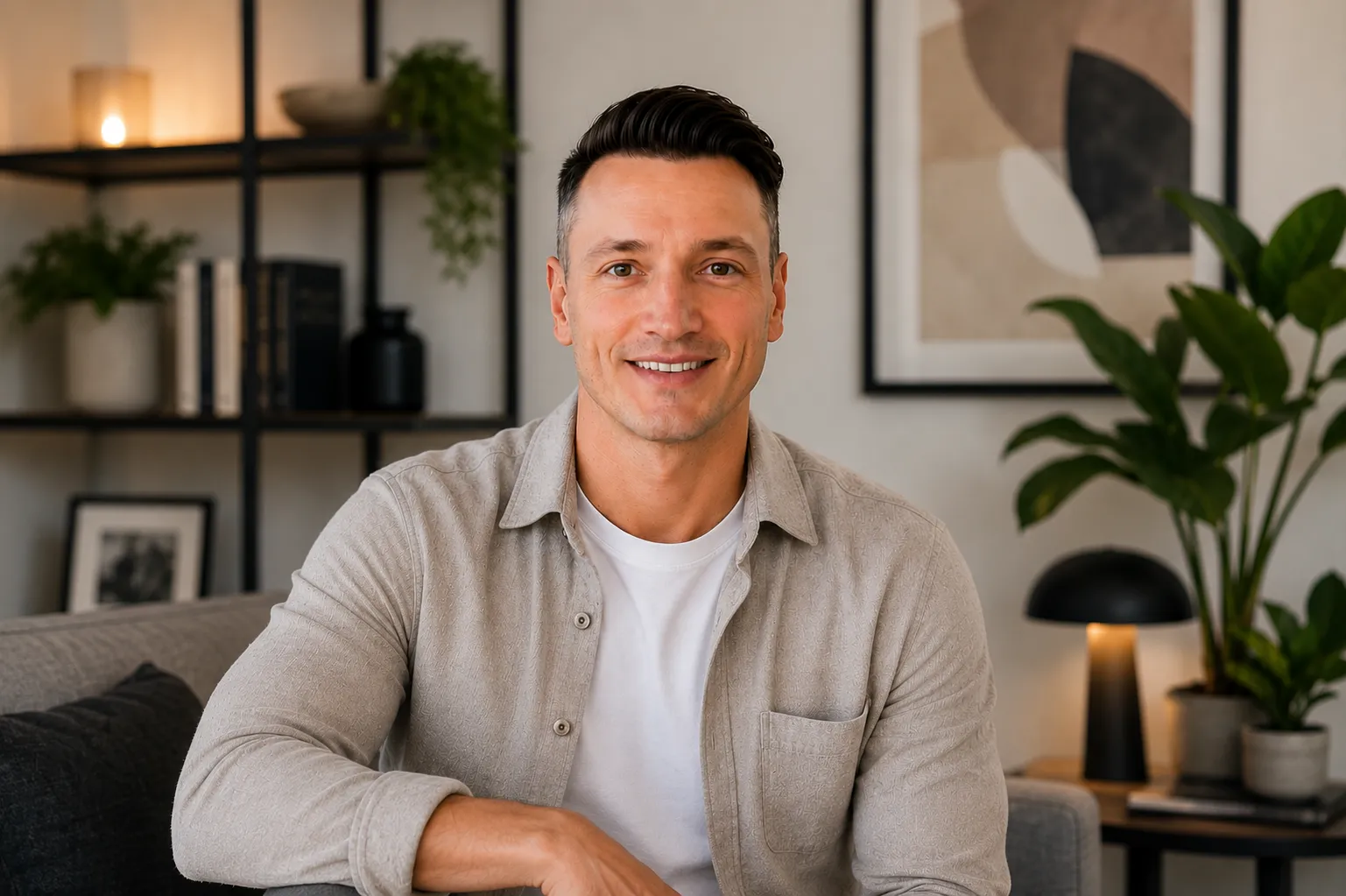
I ate my way through eight years of high-pressure work.
For years I lived on quick food while running hard at work in Shanghai. I told myself it was about time. It was not. It was about needing something easy at the end of a brutal day, every day.
What turned it around for me was not a diet. It was learning to cook real food again, paying attention to when I ate and why, and stopping the war I had been having with the kitchen. That is what I help other people find.
Let's look at what you're really eating.
A free Clarity Call to look at your real relationship with food, not your diet, and whether working together is a fit. No pressure, no number to react to before we know we can help each other.
- Restoring a Healthy Relationship with Food: Decoupling Stress and Eating. Nutrients, 2025 (peer-reviewed translational review). mdpi.com
- Hunger Games: A Modern Battle Between Stress and Appetite. Journal of Neurochemistry, 2025. wiley.com
- Probing the Neurobiology of Emotional Eating. Harvard Brain Science Initiative. brain.harvard.edu
- Oprah Winfrey's emotional eating breakthrough (the live moment with Geneen Roth). Write-up. amandamoxley.com
Educational content only, not medical or psychological advice. Patrick Labella is an integrative health coach, not a physician, dietitian, or therapist. If you are struggling with disordered eating or a serious eating issue, please consult a qualified mental health or medical professional.
- Why am I so tired after I eat?What meals do to your energy.
- Supplementation for health and performanceAn honest framework in front of the shelf.
- Digestive HealthHow well you tolerate what you eat.
- Energy & FocusYour day as feedback.
If you would rather not sort this out alone: see how working together looks.