GENES, NUTRITION & THE HONEST TRUTH
Do my genes decide what my body actually absorbs?
You eat well. You take the supplements. And you still feel like something is not landing. So you start to wonder: is it my genes? Do my genes decide what my body actually does with the food I give it? Here is the honest answer, in plain language, without the scary hype.

The short answer
Yes, your genes play a part. No, they do not run the whole show.
Your genes can change how well your body turns food into the stuff it can actually use. But they are one piece of a much bigger picture. Your sleep, your stress, your gut, and what you actually eat all matter just as much, often more. So genes are a part of the story. They are not the ending.
What a gene actually is (the simple version)
Think of your genes as a giant instruction book for building and running your body.
Every page tells your body how to make one specific tool. These tools are called enzymes. An enzyme is just a worker that does one job, like turning one thing into another thing your body can use.
So a gene is the instruction. The enzyme is the worker built from that instruction. When the instruction is clear, the worker does its job well. When the instruction is a little off, the worker is a little slower. That is the whole idea.
Gene, then worker, then result.
A gene is just an instruction for building one tiny worker. When the instruction is slightly different, the worker is slightly slower.
'Mutation' sounds scary. 'Variant' is the honest word.
You have probably seen the word "mutation" thrown around online. It sounds like something is broken inside you. Usually, it is not.
Most of these gene differences are super common. So common that scientists prefer the word "variant" instead of "mutation." A variant just means your version of the instruction is slightly different from someone else's. Not broken. Just a different setting.
Think of it like eye color. Brown, blue, green. Nobody calls blue eyes a mutation. They are just a common variation. A lot of gene differences are exactly like that. Common. Normal. Just different.
One copy or two? This part matters a lot.
Here is something the scary headlines skip. You have two copies of most genes. One from each parent. And that changes everything.
If only one copy has the different version, the other copy usually picks up the slack. The worker is a bit slower, but the job still gets done. The effect is mild.
If both copies have the different version, there is no backup. Now the job runs noticeably slower. The effect is bigger.
Scientists have names for these. One copy is called heterozygous. Two copies is called homozygous. You do not need to remember the words. Just remember the idea: one copy is usually no big deal, two copies matters more. That is why "you have the gene" is a lazy thing to say. The real question is always, one copy or two.
Why 'you have the gene' means almost nothing.
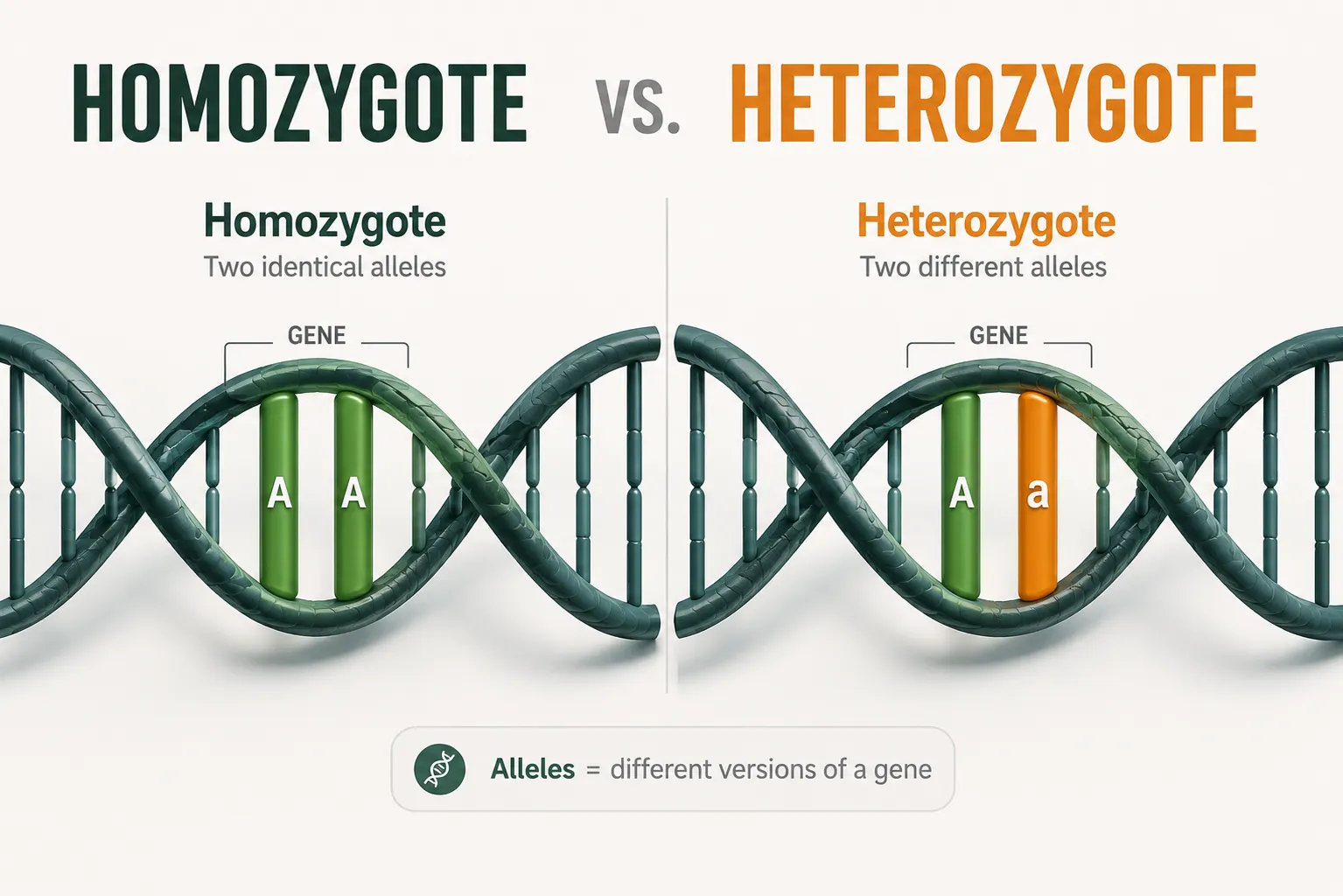
The real question is never just do you have it. It is one copy, or two.
How a variant can affect what you absorb
Here is where it touches your actual life. Some of the food you eat is not in a form your body can use yet. It has to be converted first.
Picture crude oil. You cannot pour it straight into your car. It has to be refined into gasoline first. A lot of nutrients are the same. You eat the crude oil version. An enzyme refines it into the gasoline version your cells can burn.
If the gene for that enzyme has a slower variant, the refining step is slower. You might be eating plenty of the nutrient, but less of it gets turned into the usable form. So on paper you are getting enough. In practice, your body is getting less than it looks like. That is how a gene can quietly affect what you absorb.
The most talked-about example is a gene called MTHFR, which handles one step for a B vitamin called folate. But it is far from the only one.
Why you can eat enough and still run low.
If the refining step is slow, plenty goes in but less becomes usable.
The rest of the family (and an honest warning)
MTHFR has a whole family of cousin genes that each handle a small step in the same general process. You will see names like COMT, MTR, MTRR, AHCY, and PEMT.
Each one runs a tiny part of the assembly line. COMT helps clear out stress chemicals. The others help recycle and reuse nutrients so the line keeps moving. It is genuinely interesting stuff, and science is learning more every year.
But here is the honest part, because you deserve it. The internet is full of people who will test five of these genes and then sell you an exact supplement stack, down to the milligram. The science does not actually support that level of certainty yet. These genes are real. How much each one matters for how you feel day to day is still being worked out. So treat anyone selling a precise gene-based supplement protocol with healthy suspicion. The biology is real. The marketing is usually way out ahead of the evidence.
Real genes, real biology. How much each matters day to day is still being worked out.
So should you run out and get tested?
For most people, the honest answer is: not yet, and not on its own.
A gene result tells you a tendency, not a plan. It says "this step might run slower for you." It does not say "so here is exactly what to do Monday morning." That is why the major medical groups do not recommend routine gene testing for the average person. The result usually does not change what you should actually do.
What changes how you feel right now is not a printout. It is fixing the basics your genes sit on top of. Sleep. Stress. Real food. A calm gut. Get those right, and you remove most of the load the genes were struggling under in the first place.
Where I fit in, and where this is heading.
I do not start anyone with a gene test. I start with your actual life, what you eat, how you sleep, how stressed you are, and where your body is struggling. That is what creates real results today. I will say this honestly though: I find this gene science genuinely exciting, and I believe the future of this work is bio-individual, one day using someone's genetics to fine-tune their food and support exactly to their body. That is where I want to grow. But that is tomorrow. Today, the smartest move is fixing the system you are actually living in. If you want help doing that, let's talk.
Sources
- What is a gene variant and how do variants occur? MedlinePlus Genetics, U.S. National Library of Medicine. medlineplus.gov
- ACMG Practice Guideline: lack of evidence for MTHFR polymorphism testing. Genetics in Medicine, 2013. pubmed.ncbi.nlm.nih.gov
- The influence of COMT Val158Met on physiological stress responsivity. Stress journal, 2019. tandfonline.com
Educational content only, not medical advice. Patrick Labella is an integrative health coach, not a physician. Consult a qualified healthcare provider for diagnosis or treatment.