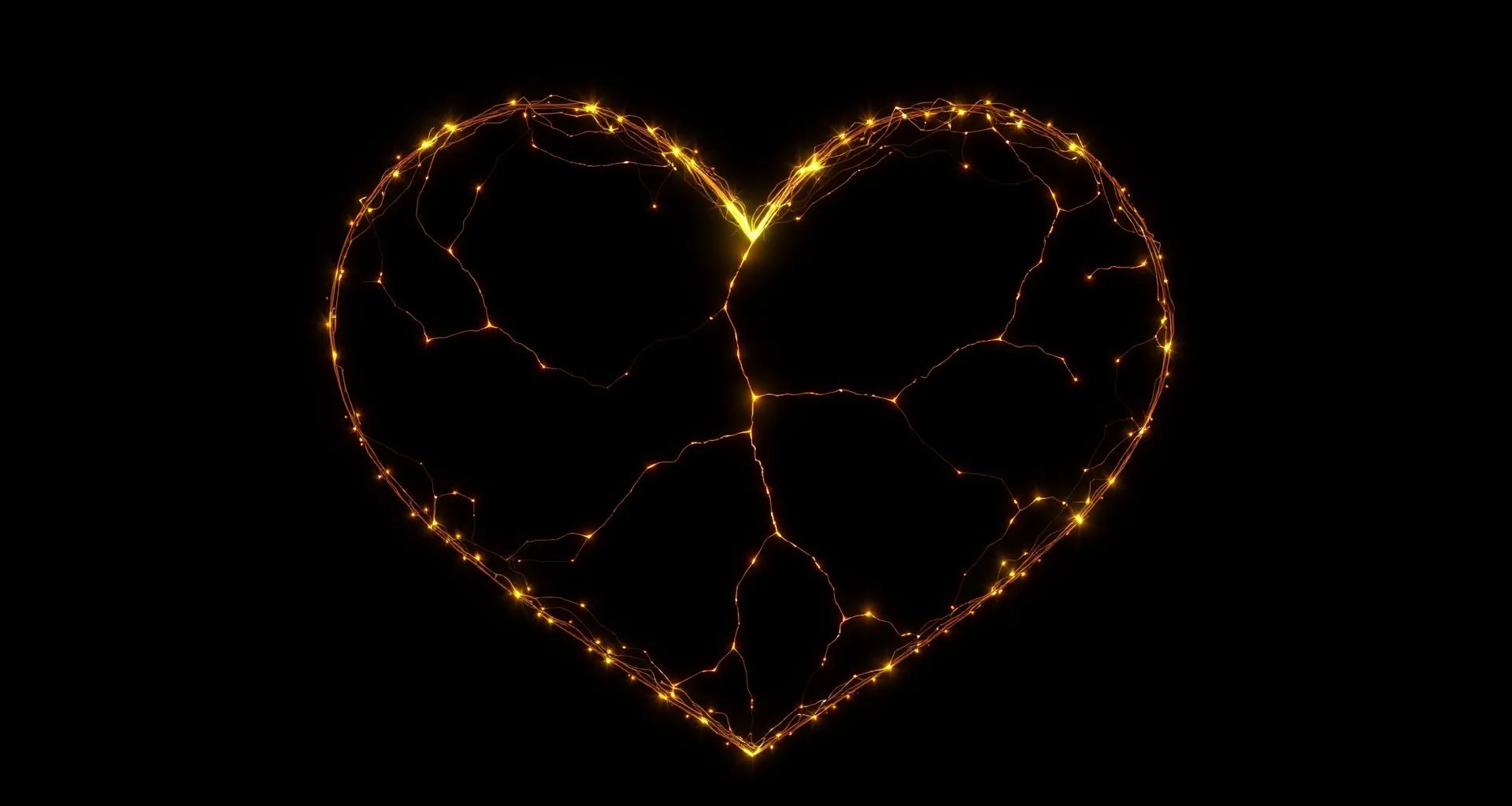
Knowledge · Body and Mind
Trauma, body and healing
An introduction to the principles of physician Gabor Maté. Why body and mind are not separate and what healing means in his understanding.
Trauma is not the event itself, it is what stays in the body when the response could never be completed. That is why it keeps acting through the nervous system, sleep, digestion and how we relate to others. Healing does not mean erasing the past, it means giving the system the safety and completion it never got.
- For Gabor Maté, body and mind are one. What is suppressed emotionally often surfaces physically.
- Trauma, as he understands it, is not the event itself but the wound a person has carried ever since. And this wound is treatable.
- Two tools stand at the center: the five levels of compassion and a five step method for working with burdensome beliefs.
- Healing, for Maté, is not a single act but a practice, often supported by others, that continues for a lifetime.
Reading time about 9 minutes. The central ideas are attributed to Gabor Maté and additional sources.
The core idea
When the body says no
The Canadian physician Gabor Maté holds a simple, consequential thesis. Body and mind are not separate realms but a unity. What a person continually suppresses in feeling does not disappear. It finds another way and often shows itself in the body (Gabor Maté, When the Body Says No).
This view contradicts the habitual split between physical and psychological complaints. Maté describes instead an interplay in which sustained stress, suppressed emotion, and early imprints become part of what later shows up as a symptom. In his most recent book he frames this as the relationship between trauma, illness, and a culture that favors both (Gabor Maté, The Myth of Normal, 2022).
The heart
More than a pump
In almost every language, the heart stands for more than an organ. We know something in our heart, we carry a broken heart, we give our heart. Maté uses this cultural experience to show how closely feeling and body are linked.
That this is not merely a figure of speech is shown by a documented condition. In broken heart syndrome, medically known as Takotsubo cardiomyopathy, a strong emotional shock can temporarily impair the pumping function of the left ventricle, triggered by a flood of stress hormones and without any blocked coronary arteries (Takotsubo syndrome, review, 2023). A feeling can therefore change a measurable cardiac function. This is exactly the point Maté makes when he questions the split between mental and physical.
A single drop creates concentric waves. An image of how a feeling reaches the entire body.
Protection and opening
The closed heart
Why do people close their hearts. Maté's answer is that as a child it was protection. When we were small, vulnerable, and deeply hurt with no way out, closing the heart was less painful. No one makes this decision consciously, it happens. The problem is that the same protection that once helped becomes a prison later (Gabor Maté, The Myth of Normal).
Maté describes how deeply grooved patterns run our lives, like a bolting horse that carries the rider along regardless of where he wants to go. Opening the heart is therefore not a single moment but continuous work, which he says he still practices well into his eighties. A clue to whether the heart is open or closed lies in the body itself. When open, there is spaciousness and calm breath. When closed, there is tightness and shallow breath.
A heavy door, opened a crack. What once protected can open again.
What trauma is
Not the event, but the wound
Maté draws a sharp line between event and wound. Trauma, as he understands it, is not what happened to a person but what happens inside them as a result, the wound they have carried ever since (Gabor Maté, The Myth of Normal).
An important thought follows. Because the wound is carried in the present and does not lie in the past, it is treatable. The past cannot be changed. The wound of today can. Maté also draws a distinction. Pain, grief, and stress are not the same as trauma. Everything traumatic is burdensome, but not every burden is trauma. Trauma is the wound that lodges in the system and has long term effects. Deep work on these wounds usually happens with support, not alone.
Trauma and addiction
Not the addiction, the pain
From twelve years of work with severely addicted people in Vancouver, Maté draws one core sentence. Addiction is always an attempt to escape pain. His formula is, in essence, not to ask why the addiction, but why the pain (Gabor Maté, In the Realm of Hungry Ghosts).
As long as addiction is read as moral failure or mere weakness of will, it remains misunderstood and untreatable. Maté locates the origin of addictive behavior not in the genes but in early imprints and emotional loss. This applies to substance addictions as well as to behavioral patterns that distract from one's own pain.
Attachment and authenticity
Two needs that belong in balance
Maté describes two basic needs every human being is born with. One is attachment, the need for closeness and belonging. The other is authenticity, contact with one's own feelings and needs (Gabor Maté, The Myth of Normal).
As children, many learn to sacrifice authenticity in order not to endanger attachment. Anyone who senses that their own truth threatens their parents' love adapts. Out of this early compromise grows a person who is always helpful, tries to please everyone, and puts their own needs last. According to Maté, the price of this adaptation often shows up only later, as exhaustion, anxiety, or physical complaints.
Attachment and authenticity belong in balance.
The five levels of compassion
Five levels of compassion
In "The Myth of Normal", Maté describes five levels of compassion that build on each other (Gabor Maté, The Myth of Normal, ch. 26).
The first is ordinary human compassion, the shared suffering when another being suffers. It is necessary but not enough on its own.
The second is the compassion of understanding. It is not enough to regret suffering. One wants to understand where it comes from. Not just that someone suffers, but why.
The third is the compassion of recognition. It is the insight that what lives in me lives in the other. The difference is a matter of circumstance, not of worth.
The fourth is the compassion of truth. It does not shield from pain, but trusts the other to see the truth, because only the truth sets free. Maté refers here to a thought of the teacher A. H. Almaas, that people only open to truth when compassion is present.
The fifth is the compassion of possibility. It sees, beneath the behavior, the expression, and the defense, the true person, who is more than what they show on the outside.
Five ascending levels of compassion.
The five steps
A method for burdensome beliefs
As a practical tool, Maté uses a method whose first four steps come from the psychiatrist Jeffrey Schwartz, originally for work with obsessive compulsive disorder (Jeffrey Schwartz, Brain Lock). Maté has applied them to addiction and to burdensome beliefs about oneself and added a fifth step (Gabor Maté, In the Realm of Hungry Ghosts). The example is a belief like "I am not lovable".
Relabel. Instead of "I am not lovable", it becomes "I have the thought that I am not lovable". As long as we believe it, it feels like reality. Named as a thought, it loses that power.
Reattribute. This thought is an old, familiar message from the brain, imprinted deeply at some point. Not the truth, but an old pattern.
Refocus. When the thought becomes overwhelming, we consciously direct attention for a few minutes to something else, ideally something active. This also includes an emergency tool for moments of overload, such as conscious, slow breathing. A well known variant counts on the inhale, hold, and exhale and is attributed to the physician Andrew Weil.
Revalue. We ask about the actual value of this belief. Most often the answer is that it keeps us small, hopeless, and stuck.
Recreate. The fifth step, which Maté adds, turns the gaze forward. A life has grown out of old, imprinted beliefs. Now it is about consciously choosing and practicing a different one, with our own values, capacities, and the wish to contribute.
Maté emphasizes that this is a practice. As with learning an instrument, repetition matters, not a single attempt.
The five steps at a glance.
A frame for healing
Four movements that healing means
For the path of healing, Maté uses a simple mnemonic, the English word HEAL. It stands for four movements (Gabor Maté, healing program).
Hearing the pain. It begins with understanding one's own trauma instead of judging oneself as bad or life as unfair.
Empowering yourself. Strategies for handling overwhelm follow, and the path back to one's own authenticity, because the core of trauma, according to Maté, is separation from oneself.
Aligning relationships. People carry their trauma into relationships. Healthy boundaries and contact with oneself belong together, also in the relationship with one's own children.
Lifelong learning. Healing is not a course that ends. It is a practice that continues.
HEAL: four movements on the path of healing.
Boundaries
A boundary is not a closed heart
A common misunderstanding is that setting a boundary and closing the heart are the same. Maté draws a clear line. Someone who closes their heart cares neither for others nor for themselves. Someone who sets a boundary can remain warm and still say a clear no.
The difference shows in the body. With a closed heart come tension, heaviness, and resentment. With a real boundary things stay calm, a clear no without hostility. Others will not always see it that way and may accuse us of being heartless. But a boundary means that the heart stays open both for others and for ourselves.
A closing image
Systems that can close themselves
An image for the possibility of healing comes from materials research. In 2023, a team at MIT showed why Roman concrete has lasted two millennia. Small lime inclusions, long considered a defect, act as built in repair. When a crack forms and water enters, these inclusions dissolve and refill the crack with newly formed lime (MIT News, 2023, original study in Science Advances).
This proves nothing about human beings. But it illustrates a principle that also underlies Maté's understanding of healing. Under the right conditions, self repair is not an exception but a property of the system.
Roman ruin in warm evening light.
Sources
Sources
- Gabor Maté, When the Body Says No.
- Gabor Maté, The Myth of Normal, 2022.
- Gabor Maté, In the Realm of Hungry Ghosts.
- Gabor Maté, official website and Compassionate Inquiry.
- Jeffrey Schwartz, Brain Lock, the four steps.
- Takotsubo cardiomyopathy, review, 2023.
- Roman concrete, self healing through lime inclusions, MIT News, 2023.
- Masic et al., Science Advances, 2023.
This article summarizes the ideas of Gabor Maté and other authors and is intended for information.